Keeping everyone in the loop with our ASB Action Plan updates
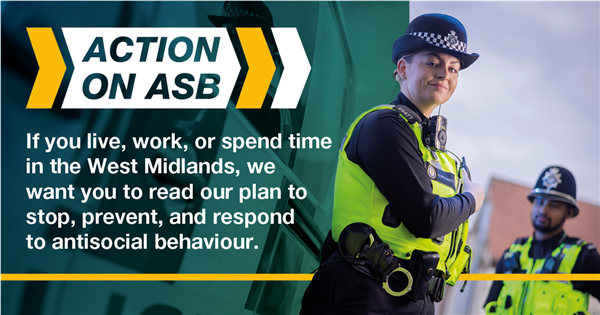
Earlier in the year, we published our plan on how West Midlands Police intends to prevent and reduce antisocial behaviour (ASB).
Our 10-point Action Plan sets out our commitment in partnership, to identify the issues that affect our communities and then and put tactics in place to tackle those issues for those who live, work and visit the West Midlands. A key objective of the plan is to have a victim and harm-focused approach to ASB. This means that the victims’ needs are always put first.
Superintendent Simon Inglis, the force’s lead for antisocial behaviour, said: "As promised, we have been updating our plan with live data and performance outputs against each of the 10 points within the plan. This shows our commitment to delivering against a plan that puts the community at the heart of activity as we tackle ASB every single day.
"At the beginning of the year, just under 13,000 of you gave your thoughts and feedback on how the force dealt with ASB issues. This ASB action plan has been shaped by your voices and has become a living document, continually updated with our specific actions, operations, and processes against each of the 10 points.
"We want to be open and transparent about our work towards tackling ASB in your neighbourhoods and so we have updated the ASB action plan with live data that helps us show you what we are doing to deliver against the plan and how we will continue doing do moving forwards. An example is the data on the number of ASB incidents that has been recorded in the last 12 months. While there has been a decrease in the number of ASB incidents since last year, we know there is still more work to be done, and we will continue to work hard to drive that number down further still.
"In addition, we recently introduced a new force ASB risk assessment process that gives victims a real voice and helps us understand the impact of ASB, both on them and their family. We have published the number of risk assessments your officers and police community support officers (PCSOs) have completed since April. These risk assessments help us identify the risk level for each victim and make sure our response is appropriate to each person's need."
In the 'Continue to learn' part of the action plan, we have also published the percentage of officers and PCSOs have completed new trauma-informed training around ASB.
Superintendent Inglis continues: “We are putting in the work to upskill our officers and PCSOs around problem-solving and risk assessment skills to ensure victims get the best level of service from us.
"My ask of you is that you talk to your local neighbourhood officers about the ASB action plan. I want the action plan to enable two-way conversation about ASB and how the force is tackling issues that matter most to you. I want to reassure you that we are listening to your concerns and taking action on ASB."
You can read the full ASB action plan, with the recent updates here.